Updated: 06-Apr-26 11:00 ET
Highlights
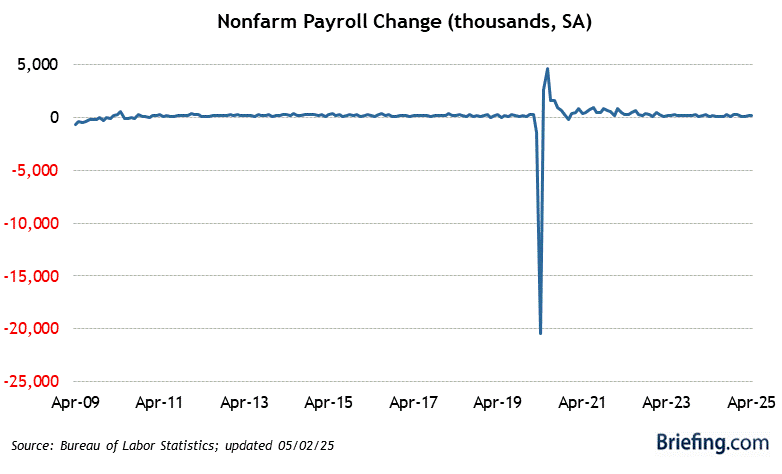
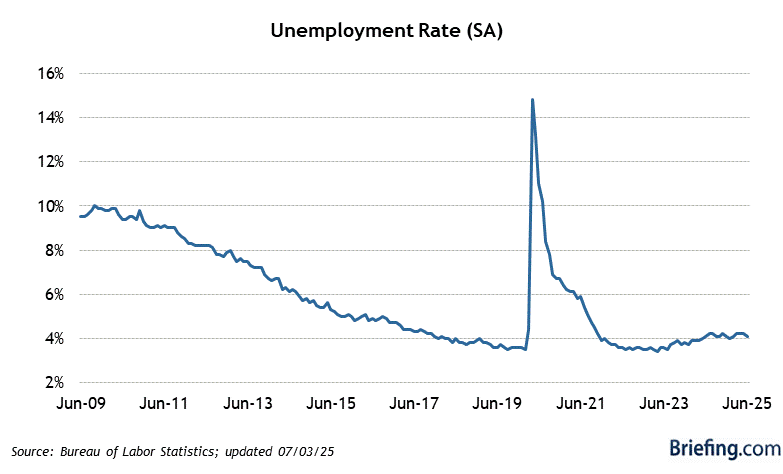
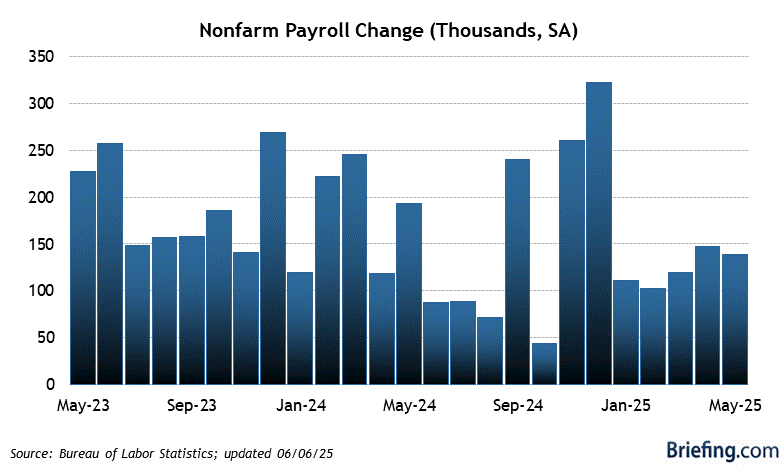
- Nonfarm payrolls rebounded strongly in March, rising by 178,000 (Briefing.com consensus 51,000) from February's downwardly revised reading (to -133,000 from -92,000). The downward revision to February (-41,000) was largely offset by an upward revision to January's reading (+34,000) and the unemployment rate unexpectedly dipped to 4.3% (Briefing.com consensus 4.4%).
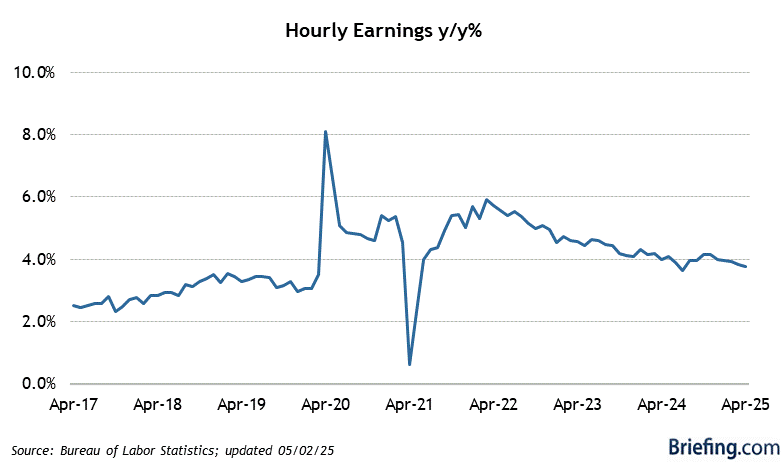
- There were a couple soft spots in the compensation side as average hourly earnings growth decelerated to 0.2% (Briefing.com consensus 0.4%), reducing the year-over-year growth rate to 3.5% from 3.8% in February, while average workweek dipped to 34.2 hours (Briefing.com consensus 34.3) from 34.3 hours. The combination produced a slight reduction in average weekly earnings (-0.1% to $1278.40).
- March nonfarm payrolls increased by 178,000 (Briefing.com consensus 51,000). The 3-month average for total nonfarm payrolls increased to 68,333 from 6,000. February nonfarm payrolls revised to -133,000 from -92,000. January nonfarm payrolls revised to 160,000 from 126,000.
- March private sector payrolls jumped by 178,000 (Briefing.com consensus 51,000). February private sector payrolls revised to -129,000 from -86,000. January private sector payrolls revised to 180,000 from 146,000.
- March unemployment rate was 4.3% (Briefing.com consensus 4.4%) versus 4.4% in February. Persons unemployed for 27 weeks or more accounted for 25.4% of the unemployed versus 25.3% in February. The U6 unemployment rate, which accounts for unemployed and underemployed workers, increased to 8.0% from 7.9% in February.
- March average hourly earnings were up 0.2% (Briefing.com consensus 0.4%) versus a 0.4% increase in February. Over the last 12 months, average hourly earnings have risen 3.5%, versus 3.8% for the 12 months ending in February.
- The average workweek in March was 34.2 hours (Briefing.com consensus 34.3) versus 34.3 hours in February. The manufacturing workweek was unchanged at 40.2 hours. Factory overtime was unchanged at 3.0 hours.
- The labor force participation rate decreased to 61.9% from 62.0% in February.
- The employment-population ratio decreased to 59.2% from 59.3% in February.
- The key takeaway from the report is that strong headline growth will calm some of the concerns that were brought to the forefront by the weak February reading, but it will also complicate the case for a rate cut since the labor side looks better now while inflation is likely to accelerate due to the recent spike in the price of oil.
| Category | MAR | FEB | JAN | DEC | NOV |
| Establishment Survey | |||||
| Nonfarm Payrolls | 178K | -133K | 160K | -17K | 41K |
| Goods-Producing | 43K | -20K | 45K | -21K | 25K |
| Construction | 26K | -13K | 45K | -7K | 36K |
| Manufacturing | 15K | -6K | 2K | -13K | -10K |
| Service-Providing | 143K | -109K | 135K | 14K | 47K |
| Retail Trade | 10K | -8K | 13K | -24K | -1K |
| Financial | -15K | 2K | -39K | 1K | 1K |
| Business | 2K | 7K | 36K | -19K | 56K |
| Temporary help | 4K | 0K | 19K | -14K | 14K |
| Education/Health | 91K | -42K | 119K | 38K | 56K |
| Leisure/Hospitality | 44K | -11K | 5K | 25K | -12K |
| Government | -8K | -4K | -20K | -10K | -31K |
| Average Workweek | 34.2 | 34.3 | 34.3 | 34.2 | 34.3 |
| Production Workweek | 33.8 | 33.8 | 33.8 | 33.7 | 33.8 |
| Factory Overtime | 3.9 | 3.9 | 3.9 | 3.7 | 3.9 |
| Aggregate Hours Index | -0.2% | -0.1% | 0.4% | -0.3% | 0.3% |
| Avg Hourly Earnings | 0.2% | 0.4% | 0.4% | 0.1% | 0.4% |
| Household Survey | |||||
| Household Survey | |||||
| Civilian Unemp. Rate | 4.3% | 4.4% | 4.3% | 4.4% | 4.5% |
| Civilian Labor Force | -369K | 18K | -1030K | -46K | |
| Civilian Employed | -64K | -185K | -895K | 232K | |
| Civilian Unemployed | -332K | 203K | -135K | -278K |